Machine Learning

Neural Network OverviewSectionA neural network is a computational model made of many simple processing units called neurons . Machine Learning FundamentalsSectionMachine learning fundamentals: probability, features, gradient descent, evaluation metrics, cross-validation,… MLOpsSectionMLOps overview: the machine learning lifecycle from features and experiment tracking to model registry,…

Machine learning is the practice of fitting a parameterised function to data so that it generalises to inputs it has not seen. This section collects reference pages on the main learning paradigms, the frameworks used to implement them, and the supporting theory (complexity, evaluation) that keeps models honest in production.

Abstract illustration of a brain rendered as circuit-board neural pathways
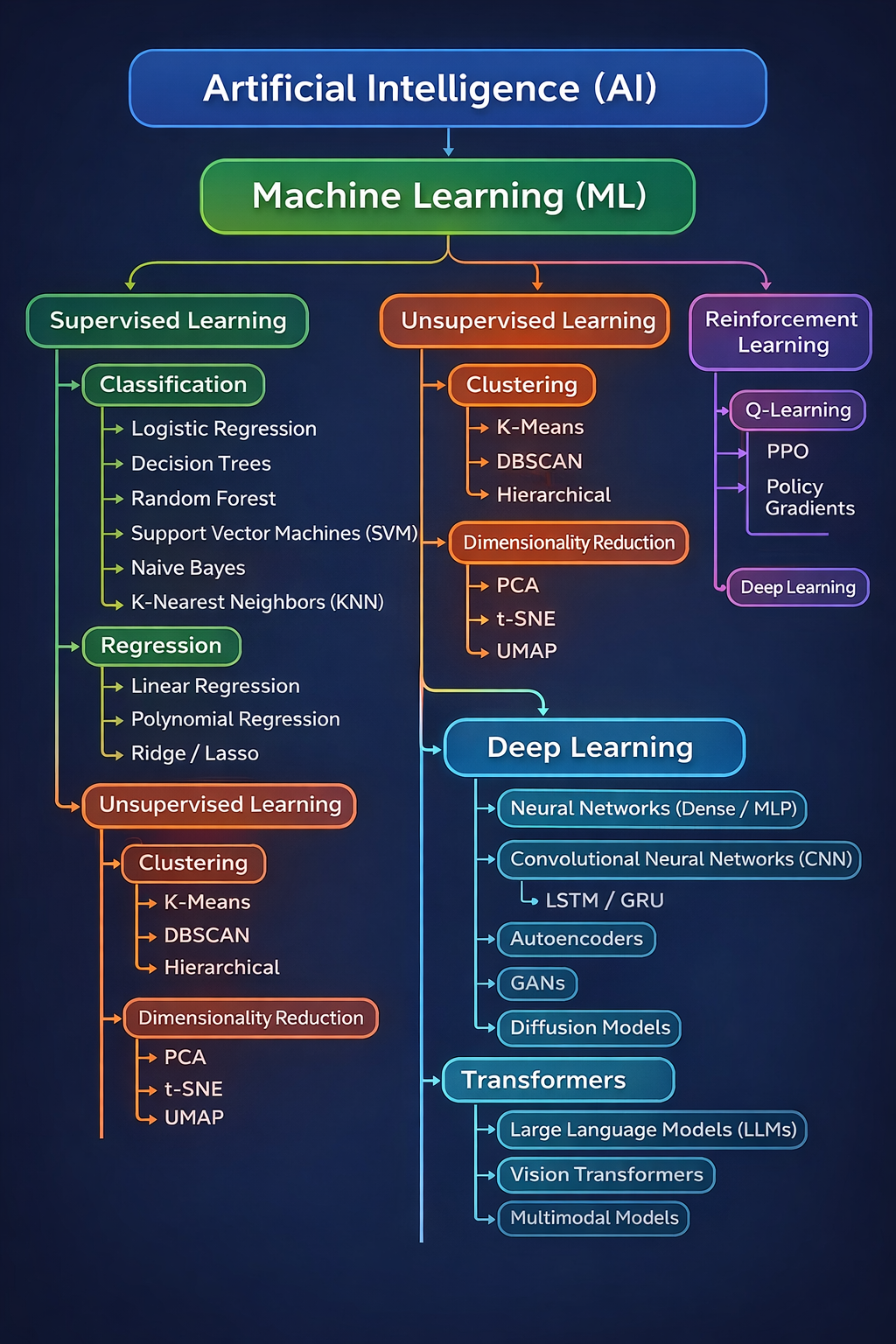
Relationship between artificial intelligence, machine learning, and deep learning

1. Overview of the area

Choosing a Learning Paradigm Your data what signal exists? Labels exist supervised No labels unsupervised Few labels semi / self-sup. Reward signal reinforcement Time-ordered forecasting Recommenders mix several paradigms: supervised ranking on top of unsupervised embeddings.

The first question for any ML problem is what kind of signal the data carries. If every example has a target value, the problem is supervised: classification for discrete targets, regression for continuous ones. If there are no targets, unsupervised methods find structure such as clusters, low-dimensional manifolds, or outliers. When only a small fraction of examples is labelled, semi-supervised and self-supervised methods use the unlabelled majority to learn representations first. When the feedback is a delayed reward from an environment rather than a correct answer, the problem is reinforcement learning. Time-ordered data adds its own constraints (no shuffling, no leakage from the future) and gets a dedicated forecasting page.

2. Topics in this section

Supervised LearningSectionclassification, regression and ensemble methods (trees, boosting, bagging) trained on labelled examples. Unsupervised LearningSectionclustering, dimensionality reduction and anomaly detection on unlabelled data. Reinforcement LearningSectionQ-learning and DQN, policy gradients, and RLHF as used to align language models. Semi- and Self-Supervised Learningmachine learningpretext tasks, pseudo-labelling and contrastive learning when labels are scarce. Time-Series Forecastingmachine learningclassical (ARIMA, exponential smoothing) and ML approaches with time-aware validation. Recommender Systemsmachine learningcollaborative filtering, content-based and two-tower retrieval plus ranking. FrameworksSectionPyTorch, Keras, scikit-learn, Hugging Face, tensors and model parameters. Time Complexity and Big-Omachine learningthe cost model used to reason about training and inference at scale.

3. When to use which

SituationStart withTypical first model
Tabular data with a labelled targetSupervisedGradient-boosted trees
Images or text with plenty of labelsSupervised + frameworkFine-tuned pretrained network
Large unlabelled corpus, few labelsSelf-supervisedPretrained encoder + small head
Segment customers, find outliersUnsupervisedk-means, isolation forest
Sequential decisions with rewardsReinforcementDQN or PPO
Predict future values of a seriesForecastingSeasonal baseline, then boosted trees
Rank items per userRecommenderMatrix factorisation, then two-tower

A practical rule: always build the simplest baseline first (majority class, last value, popularity ranking). It tells you whether a sophisticated model is earning its complexity, and it catches data leakage early when the baseline looks suspiciously strong.

Machine learning sits underneath the language-model material elsewhere on the site. The AI section covers LLM engineering and retrieval-augmented generation, which reuse the same ideas of embeddings, evaluation and fine-tuning at a much larger scale.