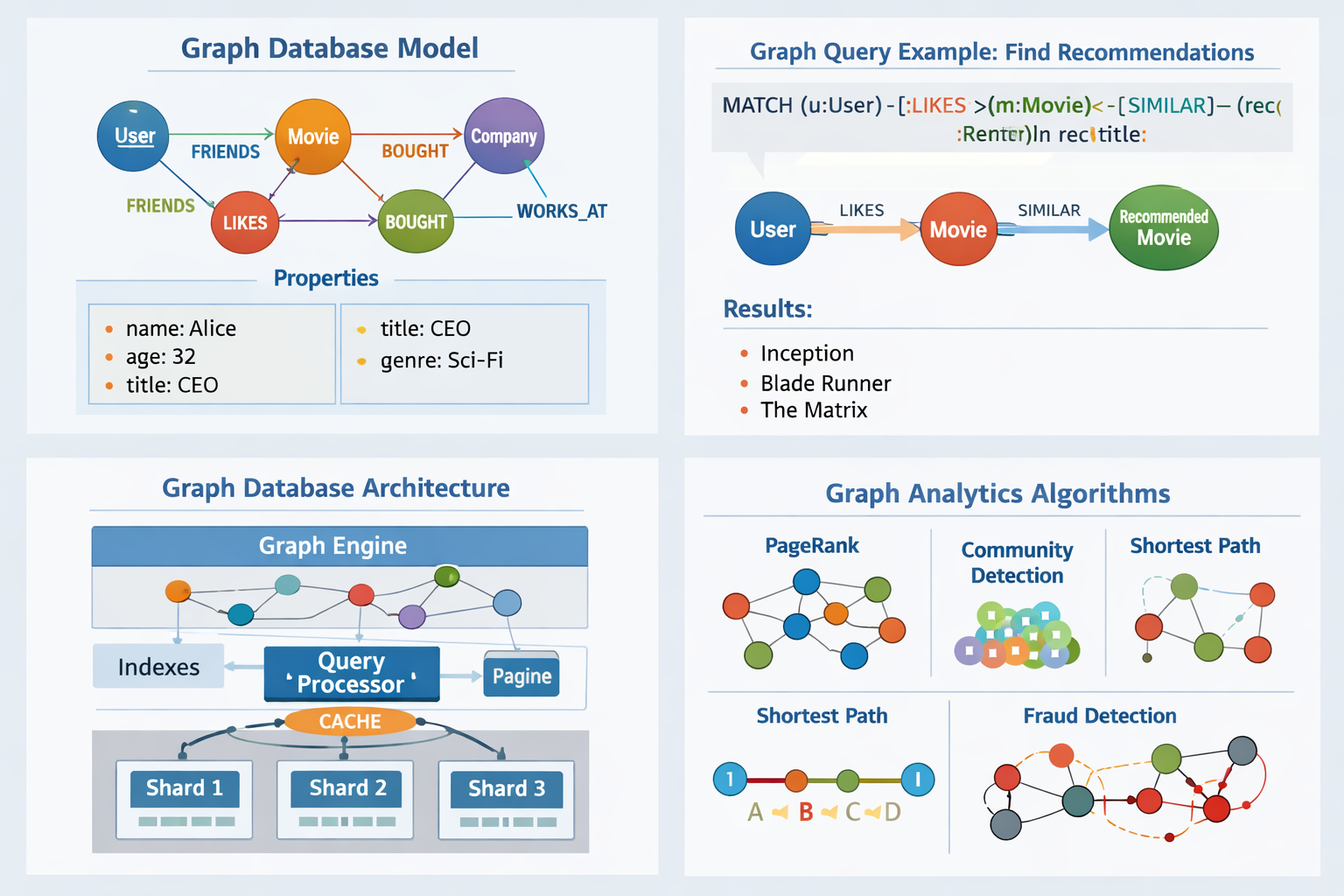
Graph databases treat relationships as first-class citizens: nodes and edges are stored natively, traversals run in constant time per hop, and multi-hop queries beat recursive SQL by orders of magnitude. Reach for them when the relationships are the data — social graphs, fraud rings, knowledge graphs, dependency maps, identity and access trees. For non-graph NoSQL engines (document, key-value, wide-column, time-series, search), see NoSQL Databases.
2. Graph Databases — Advanced Technical Details and Usages
2.1 Definition and Core Concept
A graph database is a database system designed to store, manage, and query data as a graph structure. It emphasizes relationships between entities as first-class citizens, rather than treating relationships as secondary constructs (such as foreign keys).
Nodes (Vertices) — entities or objects
Edges (Relationships) — directed or undirected connections between nodes
Properties — key–value attributes on nodes and/or edges
Graph databases are optimized for relationship traversal, pattern matching, and connected-data queries.
2.2 Graph Data Models
Property Graph Model
Nodes and edges both support arbitrary properties
Edges have direction and type
Schema-optional (schema-on-read)
Common usage: social networks, fraud detection, recommendations
RDF (Resource Description Framework) Model
Data stored as triples: subject → predicate → object
Strongly schema-driven using ontologies (RDFS, OWL)
Designed for semantic reasoning and inference
Common usage: knowledge graphs, semantic web, linked data
Labeled Property Graph (LPG)
Extension of property graph
Multiple labels per node
Used by most modern graph engines
2.3 Query Languages
Cypher
Declarative, pattern-matching language
ASCII-art style graph patterns
Optimized for readability and traversal queries
Gremlin
Imperative, traversal-based language
Part of Apache TinkerPop
Supports OLTP and OLAP traversals
SPARQL
Query language for RDF graphs
Supports reasoning and inference queries
Designed for semantic consistency
Native / Proprietary Languages
Custom optimizations for performance
Often support graph analytics primitives
2.4 Storage and Architecture
Native Graph Storage
Adjacency lists stored on disk
Pointer-based traversal
Constant-time edge traversal
Distributed Graph Storage
Graphs partitioned across nodes
Vertex-cut or edge-cut strategies
Trade-offs between locality and scalability
In-Memory Graph Engines
Entire graph stored in RAM
Microsecond-level traversals
Used for real-time decision systems
2.5 Indexing Strategies
Node property indexes — fast node lookup
Composite indexes — multi-property filtering
Relationship-type indexes — traversal pruning
Full-text indexes — graph + text search
Indexes accelerate entry points, while traversals dominate query execution time.
2.6 Query Execution and Optimization
Traversal-Based Execution
Queries executed as step-by-step graph walks
Highly efficient for deep relationship queries
Cost-Based Optimization
Cardinality estimation
Traversal ordering
Early pruning of paths
Path Explosion Control
Depth limits
Uniqueness constraints
Cycle detection
2.7 Transactions and Consistency
ACID transactions for OLTP workloads
Fine-grained locking on nodes and edges
Eventual consistency in large distributed clusters
Most production graph databases support full transactional guarantees.
2.8 Graph Analytics
Centrality Algorithms
PageRank
Betweenness centrality
Closeness centrality
Community Detection
Louvain
Label propagation
Connected components
Similarity and Path Algorithms
Shortest path
K-nearest neighbors
Node similarity metrics
2.9 Common Use Cases
Recommendation Systems
User–item relationships
Real-time personalization
Fraud Detection
Ring detection
Multi-hop transaction analysis
Knowledge Graphs
Entity resolution
Semantic inference
Network and IT Operations
Dependency mapping
Impact analysis
Identity and Access Management
Role hierarchies
Permission propagation
2.10 Integration with Modern Data Platforms
Streaming ingestion (Kafka, Kinesis)
Graph + machine learning pipelines
Hybrid architectures with relational and data lake systems
2.11 Strengths and Limitations
Strengths
Extremely fast relationship traversal
Natural modeling of connected data
Flexible schema
Limitations
Not ideal for large aggregations
Sharding complexity
Less efficient for simple tabular workloads
2.12 When to Use a Graph Database
Data is highly connected
Queries involve multi-hop relationships
Business logic depends on graph structure
Real-time traversal performance is required
Graph databases are most effective when relationships are the data, not just attributes.
3. Most Popular Graph Databases
Widely Adopted (Enterprise & Production)
Neo4j — Property graph model; Cypher query language
Azure Cosmos DB (Gremlin API) — Managed property graph service
DataStax Enterprise Graph — Graph layer built on Apache Cassandra infrastructure
These platforms represent the most commonly used graph databases across enterprise systems, open-source ecosystems, real-time applications, semantic technologies, and cloud-native architectures.